What is Lyptus?
Research question provided by:
Kirk Hansen, Northwest Certified Forestry
Research request: “Have you heard anything about a tropical wood called “Lyptus” that’s being touted as the next big thing in sustainable wood products? Apparently it’s being produced almost exclusively in Brazil by a company that’s majority owned by Weyerhaeuser. I’ve heard conflicting reports as to whether it is simply a cross of eucaplyptus varieties using traditional hybridization techniques, or a GMO. It’s hard to find much information on it on the web.” –KH
——> Results:
If Lyptus was unique and different from regular eucalyptus there would be far more scientific information available. The reason their isn’t is that it has more to do with branding than any silvic uniqueness. In terms of the story of where all this Eucalyptus is heading realize that a hundred years ago much of California was planted in these trees a and to this day everyone talks of what a bad idea it was. Californians all know what an invasive nuisance these trees tend to be. Meanwhile in less developed nations it’s become the tree of life.
Eucalyptus is a primary plantation crop of Latin America, Africa, and Asia. These trees have been known to dry up rivers, as well as eliminate native plant diversity.
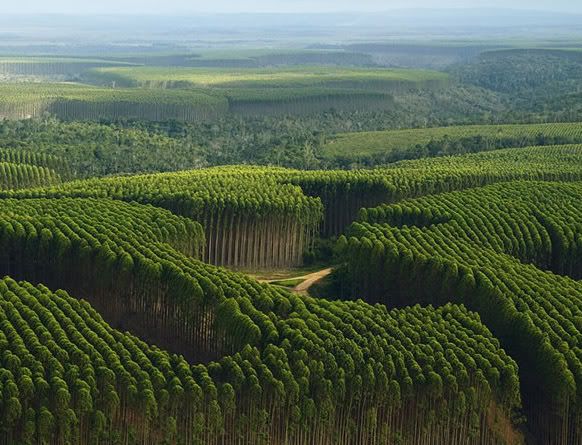
So when we hear pronouncements of all the “earth savers” who plant trees, why don’t we want to know if they’re planting the right kind of trees? For the most part the world still doesn’t differentiate much between healthy and unhealthy kinds of trees to plant. I’ve worked with landowners from Brazil who believe they are actually restoring the forest by planting Eucalyptus trees on their land. And as we know with land owners it’s important to encourage rather than discourage their desire to restore their forest… So I tell ‘em to plant other native trees among the Eucalyptus that they’ve already planted. I try to teach the idea that they need to create greater diversity. Not too sure which Natives will be able to survive though?
The antithesis of Lyptus as the next big thing: The Green Deserts resistance! This movement is primarily indigenous people who have run out of water because the density of the Eucalyptus trees have lowered the water table to below the elevation of their creeks and stream. The Global Justice Ecology Project is my favorite advocate for the indigenous people who oppose Green Deserts. They have covered the tribes in Peru who have clearcut and occupied plantations as an act of reclaiming their native land. They’ve also done much to represent indigenous rights at UN meetings, as well as other types of conferences. Other hot spots in resistance to Eucalyptus plantations are along the Paraguay-Uruguay border, and more recently a women’s movement took over and briefly occupied a Stora-Enso plantation in Brazil.
FSC certifies green deserts in various places around the globe! Something we might encourage them away from at this point, especially because indigenous cultures are sometimes extirpated by plantation-based policies.
On a government policy level in Australia (where the Eucalyptus is indigenous) planners have begun to request plantation owners do analysis of in-soil water use and evapotranspiration rates (green water) for proposed forest plantations. This means they need to asses how much their plantations will lower the water table, dry up creeks and streams, effect cloud cover and rainfall. In terms of in-stream flows It’s gotten so bad down in Australia that their equivalent of the Mississippi, which is the Murray-Darling river basin hardly ever flows to the ocean!
I’m most fascinated by this subject matter in that one day I’d like to see forestry account for a favorable balance of instream flows vs. tree growing evapotranspiration rates. To hold forest managers accountable for water overuse caused by fast grown densely packed plantation stands that limit in-stream flows seems reasonable to me. This requirement might redefine the necessity of forest-meadow mosaics, which are currently defined by the convenience of cutblock harvest systems. The idea is we need to return to planting indigenous trees in ways that are compatible with the landscapes actual hydrologic capacity / fecundity
–DeaneTR
April 21st, 2008 in
Forest Certification
Kirk Hansen
Your PIcture of the Lytus forest is awesome, we sell the lyptus product, and I would love to get a large picture of the forest scene with the roads, it really shows the size of the trees.
Would you send me the picture in a large file so I could blow it up, into a large picture.
Would you please respond to me harveyj@mastercraftfd.com
Thanks for your consideration